Caucasus Investment Group · caucasusinvestmentgroup.com
Azerbaijan After Peak Oil: What the Non-Oil Economy Can Carry
Azerbaijan's balance sheet is among the strongest in emerging markets, but oil output is falling, the oil fund now pays out more than it receives from oil and gas, and the non-oil economy has slowed just as it is asked to carry more.
- 1Oil output, including condensate, fell from 41.0 million tonnes in 2016 to 27.7 million in 2025. The giant ACG field produced about 330,000 barrels a day in 2025, against a 2010 peak of about 823,000.
- 2The non-oil economy has slowed sharply: growth fell from 9.1% in 2022 to 2.7% in 2025 and 1.5% in the first half of 2026. With oil also falling, total GDP grew only 1.4% last year.
- 3The State Oil Fund paid AZN 14.5bn into the budget in 2025 while receiving AZN 10.3bn from oil and gas. Its assets still rose, to USD 73.5bn, because of currency and gold revaluation and investment returns.
- 4Buffers are very large. Strategic reserves of about USD 86bn and public debt of about 20% of GDP support investment-grade ratings from Fitch and Moody's.
- 5Gas is the growth leg, but exports have plateaued at 25.2 bcm and Europe took 12.8 bcm in 2025, well short of the 20 bcm target for 2027. New fields arrive mainly from 2029.
An economy built on one field
Azerbaijan’s modern economy rests on a single offshore field complex. Azeri-Chirag-Gunashli (ACG), operated by bp in the Caspian, produced about 823,000 barrels a day at its peak in 2010. In 2025 it produced about 330,000, according to bp. Total oil output, including condensate from gas fields, has fallen in most years since the middle of the last decade, from 41.0 million tonnes in 2016 to 27.7 million in 2025, according to SOCAR and the Ministry of Energy.
Azerbaijan's oil output has fallen by a third in a decade
Oil production including condensate, million tonnes, 2016–2025
The decline has slowed. The USD 6bn Azeri Central East platform, which started producing in April 2024, offsets part of the natural fall from ageing reservoirs, and output fell 4.8% in 2025 against 7% in 2023. None of the projects now in development is expected to reverse the trend: the IMF’s medium-term projections assume oil-sector output keeps falling by about 0.5% a year, and the government’s 2026 budget assumed a 3.3% fall in oil and gas GDP.
This matters because oil still pays much of the state’s bills. Oil and gas revenues are expected to make up 39.5% of state revenues in the draft 2027 budget, according to the Ministry of Finance, and hydrocarbons made up about two-thirds of goods exports in the first half of 2026 (USD 10.8bn of USD 16.3bn on customs data published by the central bank), a share held down by large gold shipments; in 2024 it was about 87%.
The non-oil economy has slowed
Official figures show the economy diversifying. The non-oil sector was 71.5% of GDP in 2025, according to Ministry of Finance budget documents, and industry, which is dominated by oil and gas, fell from 51.1% of GDP in 2022 to 33% in 2025.
Much of that shift is about prices and volumes in oil rather than strength elsewhere. Non-oil growth has fallen sharply:
Azerbaijan's non-oil growth has slowed sharply since 2022
Real growth, %, 2020–2025
The non-oil economy grew 9.1% in 2022, 3.7% in 2023 (a World Bank figure), 6.2% in 2024 and 2.7% in 2025, according to the State Statistical Committee, and 1.5% in the first half of 2026. With oil and gas falling 1.6%, total GDP grew 1.4% in 2025. In the first quarter of 2026 construction contracted by 19.8% in real terms.
Construction is the clue. A large part of non-oil activity in recent years has been public investment, much of it in Karabakh and East Zangezur, the territories Azerbaijan regained in 2020 and 2023. The finance minister said in September 2026 that about USD 25bn had been spent there over six years. That spending supports non-oil growth, but it is financed by oil money passing through the budget. When it slows, so does the non-oil economy.
Forecasts for 2026 diverge. The IMF projected growth of 2.2% in March, with non-oil growth of 3.7%. The central bank, in July, projected 0.5%, with non-oil growth of 2.4%. Most of the gap comes from different views of non-oil growth, and both put it well below the rates of 2022 and 2024.
The oil fund has started to draw down
The State Oil Fund of Azerbaijan (SOFAZ) is the centre of the country’s fiscal system. Its assets rose 22.5% in 2025 to USD 73.5bn at the end of the year, about 97% of GDP according to the IMF. Read quickly, that suggests a fund still accumulating oil wealth.
It is not. In 2025 SOFAZ received AZN 10.3bn in oil and gas revenues and transferred AZN 14.5bn to the state budget. The rise in assets came from AZN 20.4bn of currency and gold revaluation and AZN 6.9bn of investment returns, not from saving oil income. In the first half of 2026 the fund again paid more into the budget, AZN 6.4bn, than it received from oil and gas, AZN 5.0bn, and a revaluation loss of AZN 3.7bn turned the result into a fall: assets dropped 1.3% to USD 72.6bn.
The oil fund now pays out more than it receives from oil and gas
SOFAZ oil and gas revenue and transfers to the state budget, AZN bn
The government plans to reduce the transfers: AZN 12.8bn in the 2026 budget, according to Report.az, then AZN 11.9bn in the draft for 2027 and about AZN 9.4bn by 2030, according to budget documents reported by Caliber.az. That taper is the real fiscal adjustment. It works only if non-oil tax revenue grows fast enough to replace the money, at a time when non-oil growth has slowed. Non-oil sources provided 75% of tax revenue in the first eight months of 2026, according to the Ministry of Finance, but much of that tax base is itself tied to state spending.
Azerbaijan’s buffers are very large. The cash flow that built them is shrinking.
CIG view
Very strong buffers
None of this points to a near-term crisis. Azerbaijan’s balance sheet is unusually strong. Strategic reserves, the central bank’s and SOFAZ’s foreign assets combined, were USD 85.8bn at the end of June 2026, enough to cover 40 months of imports, according to the central bank. Public debt was about 20% of GDP in 2025, according to the IMF. The current account ran a surplus of 5.5% of GDP in 2025, according to the IMF.
Rating agencies have rewarded this. Fitch upgraded Azerbaijan to investment grade, BBB-, in July 2024 and affirmed it in June 2026. Moody’s upgraded it to Baa3 in July 2025, citing expected reductions in dependence on oil and gas, the Middle Corridor and the development of Karabakh, and has a positive outlook. S&P moved its outlook to positive in December 2025, keeping a BB+ rating, and then withdrew the rating at the government’s request.
The manat has been held at AZN 1.70 to the US dollar, which the IMF describes as a de facto peg and recommends keeping. The IMF also judges the external position “substantially weaker” than medium-term fundamentals warrant. In our view, that means the peg is sustained by the stock of savings more than by current earnings. The central bank cut its policy rate to 6.5% in February 2026 and has held it since; in September it lowered the floor of its interest-rate corridor from 5.5% to 5.0% to deal with excess liquidity. Annual inflation was 5.7% in August.
Gas is the growth leg, with a delay
If oil is the past, gas is meant to be the bridge. Production reached 51.5 bcm in 2025, up 2.4%, according to the Ministry of Energy, led by the Shah Deniz field. Exports were 25.2 bcm, the same as in 2024: 12.8 bcm to Europe, 9.6 bcm to Turkey, 2.3 bcm to Georgia and 0.5 bcm to Syria.
Gas exports to Europe have plateaued well short of the 20 bcm target
Azerbaijani gas exports, bcm. The EU–Azerbaijan target is at least 20 bcm a year to the EU by 2027
In July 2022 the European Union and Azerbaijan agreed a target of at least 20 bcm a year of gas to the EU by 2027. Exports to Europe have been flat at 11.8 to 12.9 bcm a year since 2023. The Trans Adriatic Pipeline, which carries the gas into Greece, Albania and Italy, added 1.2 bcm a year of capacity from January 2026, according to TAP AG, and a further expansion depends on a market test that was still in its non-binding phase in July 2026, with a decision expected in early 2027. Analysts at S&P Global said in 2023 that the 20 bcm target would require aggressive upstream and pipeline investment.
That investment is now being committed, but it arrives late. bp and its partners approved the USD 2.9bn Shah Deniz Compression project in June 2025, adding about 50 bcm of recoverable gas, with first gas expected in 2029. TotalEnergies, SOCAR and ADNOC’s XRG took the investment decision on the full development of the Absheron field in September 2026, raising output from 1.5 bcm a year to 6 bcm a year from 2029, mainly for the domestic market and Turkey. bp began producing gas from deeper ACG reservoirs in June 2026, later than first guided. The gas story is real, but most of the new volume is a 2029 event, not a 2027 one.
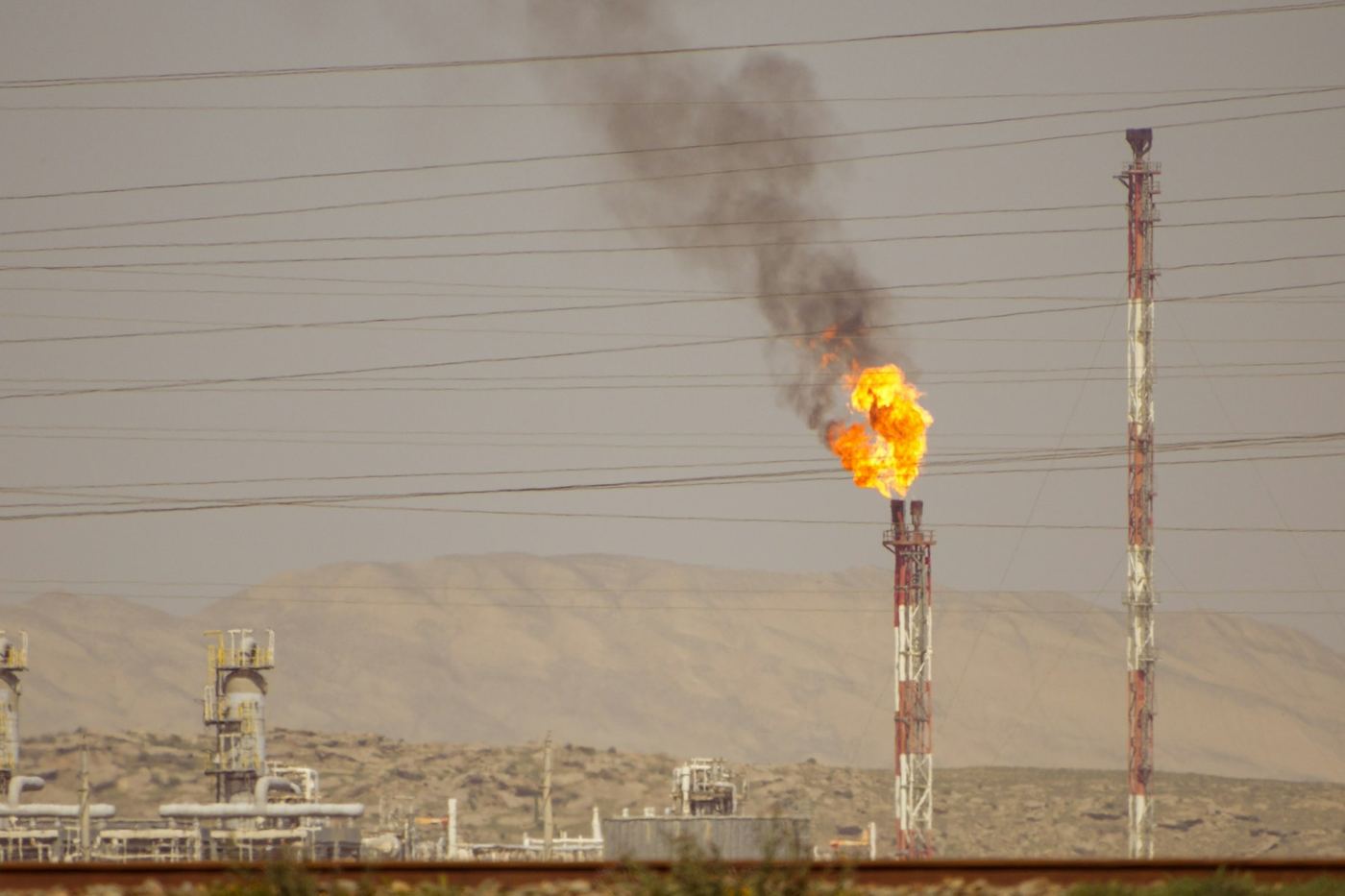
Gas flaring on the Absheron peninsula. Photo by Anatoly Maltsev, Unsplash.
Renewables help at the margin by freeing gas for export. The 230 MW Garadagh solar plant built by Masdar, opened in 2023, and the 240 MW Khizi-Absheron wind farm built by ACWA Power, opened in January 2026, together save about 330 million cubic metres of gas a year, according to official figures. The government says it has signed contracts for 6 GW of wind and solar by 2030. Azerbaijan hosted the COP29 climate conference in Baku in November 2024, and has positioned itself as the start of a green electricity corridor to Europe through Georgia and a planned Black Sea cable, agreed with Georgia, Romania and Hungary in December 2022.
A thin private sector and a small market
The private economy outside energy is shallow. Bank assets were AZN 58.8bn at the start of December 2025, about 45% of GDP, and net loans about 22% of GDP, a CIG calculation from central bank data. New manat loans carried an average rate of 18.6% in mid-2026, against a 6.5% policy rate, according to the central bank. Credit is expensive and transmission from policy rates is weak.
Foreign direct investment remains concentrated in energy. Of USD 6.6bn of gross FDI inflows in 2025, 78.1% went to oil and gas, according to central bank data reported by Caliber.az.
The Baku Stock Exchange had a market value of AZN 3.65bn (about USD 2.15bn) in the first half of 2026, 99% of it financial companies, with secondary-market turnover of AZN 8.8m in six months, according to the exchange’s bulletin. The most notable recent event was PASHA Bank’s initial public offering, completed in June 2026: 5% of the bank sold at AZN 55 a share, raising about AZN 51m from more than 18,000 investors. It was a useful test of domestic retail demand rather than evidence of a functioning equity market.
The best-known corporate credit is SOCAR, the state oil company. It reported revenue of AZN 86.3bn and EBITDA of AZN 10.9bn for 2025, according to Trend, and has a USD 750m Eurobond due in 2030 outstanding. Moody’s rates SOCAR Baa3, in line with the sovereign.
Peace, Russia and the corridor
Geopolitics has moved in Azerbaijan’s favour. At the White House in August 2025 Armenia and Azerbaijan initialled a peace treaty, and the United States extended the waiver of Section 907 of the Freedom Support Act, which restricts US government aid to Azerbaijan; the State Department notified Congress of a further extension in July 2026. As of August 2026 the treaty had not been signed. Baku wants Armenia to remove a reference in its constitution’s preamble, which requires a referendum that Armenia’s governing party, after the June 2026 election, lacks the parliamentary majority to call.
Relations with Russia were badly strained in 2025, after an Azerbaijan Airlines aircraft crashed near Aktau in December 2024 having been hit by Russian air defences, which President Putin acknowledged in October 2025, and after two Azerbaijani men died in Russian police custody in June 2025. Trade did not suffer. Turnover with Russia rose 2.5% to USD 4.9bn in 2025, according to the State Customs Committee, and Russia remained the largest buyer of Azerbaijani non-oil goods.
Transit is the other part of the diversification case. Container traffic through the Port of Baku rose 39% in 2025, according to World Bank figures reported by Trend. Azerbaijan’s transport-services surplus was about USD 856m in the first half of 2025, according to the central bank as reported by Report.az, a useful sum but small next to hydrocarbon exports of USD 10.8bn in the first half of 2026.
Investment implications
Azerbaijan is a strong credit with a weakening growth model. The sovereign and SOCAR are the main investable instruments for foreign capital, and the case for them rests on buffers worth roughly a year of GDP, low debt and investment-grade ratings. Those buffers make a disorderly adjustment unlikely for years.
The equity case is harder. The market is small and almost entirely financial, and the private economy outside energy is shallow and credit-starved. The PASHA Bank listing matters as a precedent; further private or state-company listings would be the signal that a domestic equity market is forming.
The questions that will decide the next five years are fiscal. Can non-oil revenue replace a shrinking SOFAZ transfer without cutting the public investment that drives non-oil growth? Does gas investment arrive on time in 2029? And does the peace process turn into a signed treaty that opens new trade routes? What to watch: non-oil GDP growth, SOFAZ’s quarterly inflows against transfers, gas exports to Europe, TAP’s expansion decision expected in 2027, construction activity, and any new listings on the Baku exchange.
The authors have no relationships with the entities discussed in this publication.
Sources & methodology
- State Statistical Committee of Azerbaijan · GDP 2025, as reported by Report.az, 19 January 2026
- State Statistical Committee of Azerbaijan · GDP H1 2026, as reported by Interfax, 10 July 2026
- State Statistical Committee of Azerbaijan · GDP 2020
- State Statistical Committee of Azerbaijan · GDP 2022, as reported by Interfax
- State Statistical Committee of Azerbaijan · GDP 2024, as reported by AZERTAC
- Ministry of Energy of Azerbaijan · Oil production 2025, as reported by AZERTAC, 12 January 2026
- Ministry of Energy of Azerbaijan · Gas production and exports 2025, as reported by AZERTAC, 12 January 2026
- Ministry of Energy of Azerbaijan · Oil and gas production 2024, 15 January 2025
- Ministry of Energy of Azerbaijan · Oil and gas production 2022
- State Oil Fund of Azerbaijan (SOFAZ) · 2025 results, 27 January 2026
- State Oil Fund of Azerbaijan (SOFAZ) · H1 2026 results, 23 July 2026
- Central Bank of Azerbaijan · Monetary Policy Review, August 2026
- Centre for Analysis of Economic Reforms and Communication · Export review, H1 2026
- Ministry of Finance of Azerbaijan · 2027 budget indicators, as reported by Trend, 16 September 2026
- International Monetary Fund · Republic of Azerbaijan: 2026 Article IV Consultation, Country Report No. 26/112
- World Bank · Macro Poverty Outlook for Azerbaijan, April 2024 (2023 non-oil growth)
- UNFCCC · COP29 outcome on climate finance, 24 November 2024
- Moody's · Sovereign upgrade to Baa3, 3 July 2025, as reported by APA
- Fitch Ratings · Affirmation at BBB-, June 2026, as reported by Caliber.az
- S&P Global Ratings · Ratings affirmed and withdrawn, 6 December 2025, as reported by Report.az
- US Government · Presidential Determination No. 2025-08 on Section 907, 8 August 2025
- bp Azerbaijan · 2025 full-year results (ACG and Shah Deniz)
- bp Azerbaijan · 2019 full-year results
- TAP AG · Five years of operations and 1.2 bcm/y expansion, 15 November 2025
- Azerbaijan Renewable Energy Agency · 230 MW Garadagh solar plant
- President of Azerbaijan · Opening of the Khizi-Absheron wind farm, 8 January 2026
- Neftegaz.ru · SOCAR production data for 2018
- AZERTAC · Oil production 2016–2017, citing SOCAR, 15 January 2018
- Report.az · Oil production 2020, citing the Ministry of Energy, 5 February 2021
- OC Media · ACG output and the Azeri Central East platform, 21 October 2025
- WorldOil · Shah Deniz Compression final investment decision, 3 June 2025
- Enerdata · Absheron full-field development FID, 29 September 2026
- Offshore Technology · bp starts ACG non-associated gas production, June 2026
- Trend · Port of Baku 2025 throughput, citing the World Bank, 28 September 2026
- Trend · SOCAR 2025 results, 27 August 2026
- Trend · Baku Stock Exchange Q2 2026 bulletin, 22 September 2026
- Trend · PASHA Bank shares begin trading, 24 June 2026
- Trend · Karabakh reconstruction spending, Finance Minister, 25 September 2026
- Caliber.az · FDI in 2025, citing the Central Bank of Azerbaijan, 18 March 2026
- Caliber.az · 2027 budget: non-oil share of GDP and SOFAZ transfers, 19 September 2026
- Report.az · Banking sector at 1 December 2025, citing the central bank
- Interfax · Central bank holds refinancing rate at 6.5%, 31 July 2026
- Interfax · Azerbaijan–Russia trade in 2025, citing the State Customs Committee, 21 January 2026
- Armenian Weekly · Section 907 waiver extension notified to Congress, 6 August 2026
- Armenpress · Peace treaty initialled, 2025
- Interfax · Central bank holds rate, narrows corridor floor, 23 September 2026
- Report.az · Transport services surplus H1 2025, citing the central bank
- Report.az · SOFAZ 2026 budget, 29 December 2025
- Wikipedia · 2025 Azerbaijan–Russia diplomatic crisis (summary of Reuters, AP and Al Jazeera reporting)
- RFE/RL Azatutyun · Peace treaty and Armenia's constitution, 4 August 2026
- S&P Global Commodity Insights · Will Azerbaijan meet Europe's 2027 gas demand deadline?, May 2023
Oil figures include condensate and come from the Ministry of Energy, except 2016–2017 (SOCAR), 2018 (SOCAR data reported by Neftegaz.ru) and 2019, which is a CIG calculation from the ministry's statement that 2020 output was 3.0 million tonnes lower. 2023 oil-sector growth is not shown because no full-year official figure was found. Non-oil export figures use CAERC data, which exclude non-monetary gold; the central bank's wider 'non-oil-gas exports' measure includes gold shipped mainly to the UK and is not comparable. SOCAR's 2025 results are taken from Trend's report and have not been checked against SOCAR's audited statements. Manat figures are converted at the official rate of AZN 1.70 per US dollar.
William Shalva Maisashvili (2026). Azerbaijan After Peak Oil: What the Non-Oil Economy Can Carry. Caucasus Investment Group, 7 October 2026. https://caucasusinvestmentgroup.com/research/azerbaijan-after-peak-oil/
This publication is independent research provided for information only. It is not investment advice, a recommendation or an offer to buy or sell any security. See the research disclaimer.